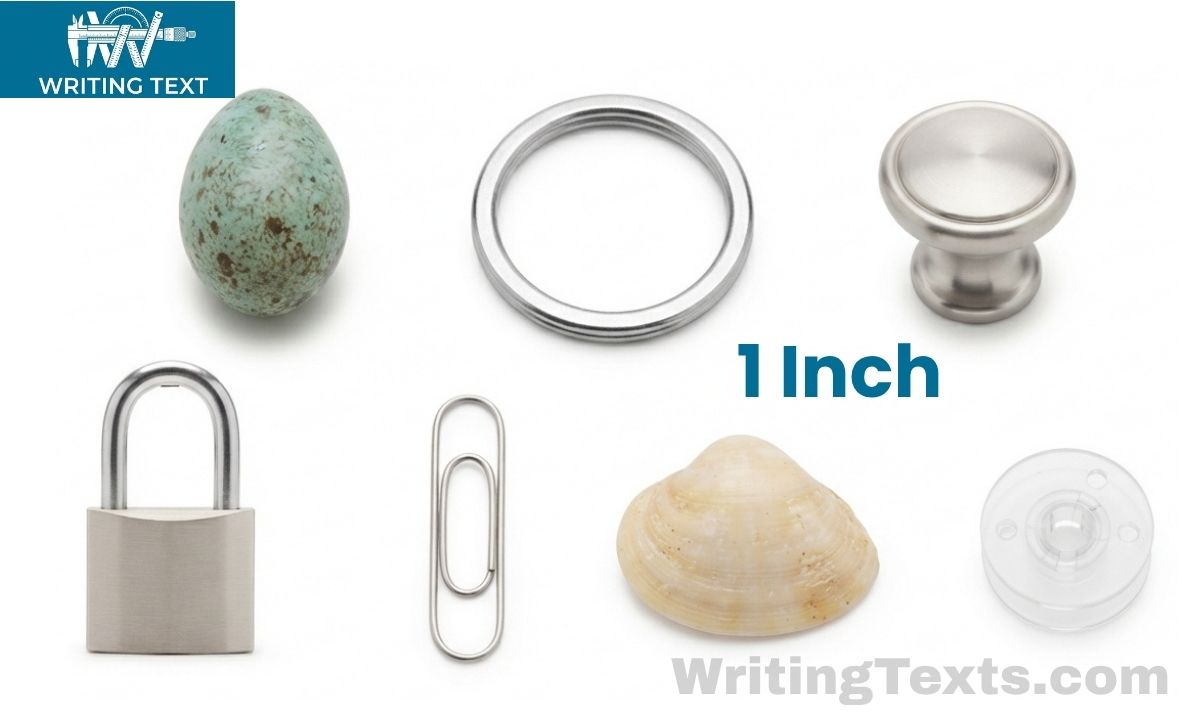
You’re trying to figure out if a cabinet knob will fit a drilled hole, or whether a replacement watch band will clear the lugs and your ruler is nowhere close. Knowing how long is 1 inch makes these calls fast and accurate. This guide gives you twelve physical objects you can reference right now, wherever you are, to lock in that measurement instantly.
How Long is an Inch?
One inch measures 2.54 centimeters, and a standard paperclip is commonly around 1 inch in total length making it one of the most universally accessible reference points for this measurement. One inch is also equal to one-twelfth of a foot, or roughly 0.0278 yards.
Quick Conversions Chart
| Unit | Value |
| Inch | 1 in |
| Centimeter | 2.54 cm |
| Millimeter | 25.4 mm |
| Foot | 0.0833 ft |
| Yard | 0.0278 yd |
| Meter | 0.0254 m |
12 Common Things That Are 1 Inch Long
| Object | Category | Portion Measured | Measurement Accuracy |
| Blue Jay Egg | Nature | Length (short axis) | Approximate |
| Heavy-Duty Key Ring | Hardware | Outer Diameter | Approximate |
| Standard Cabinet Knob | Home Hardware | Face Diameter | Approximate |
| Gym Locker Padlock | Security Hardware | Shackle Clearance | Approximate |
| Standard Paperclip | Office Supply | Total Length | Approximate |
| Coquina Seashell | Nature | Width | Approximate |
| Medium Binder Clip | Office Supply | Mouth Width | Approximate |
| Class 15 Sewing Bobbin | Sewing Supply | Diameter | Approximate |
| Large Watch Band | Accessories | Lug Width | Approximate |
| Square Mosaic Tile | Building Material | Face Width | Approximate |
| Natural “Pinch” Width | Human Anatomy | Thumb-to-Index Span | Approximate |
| CPU Thermal Paste Line | Electronics | Application Line Length | Approximate |
Related: How Long Is 2 Inches? 16 Common Things That Are 2 Inches Long
1. Blue Jay Egg
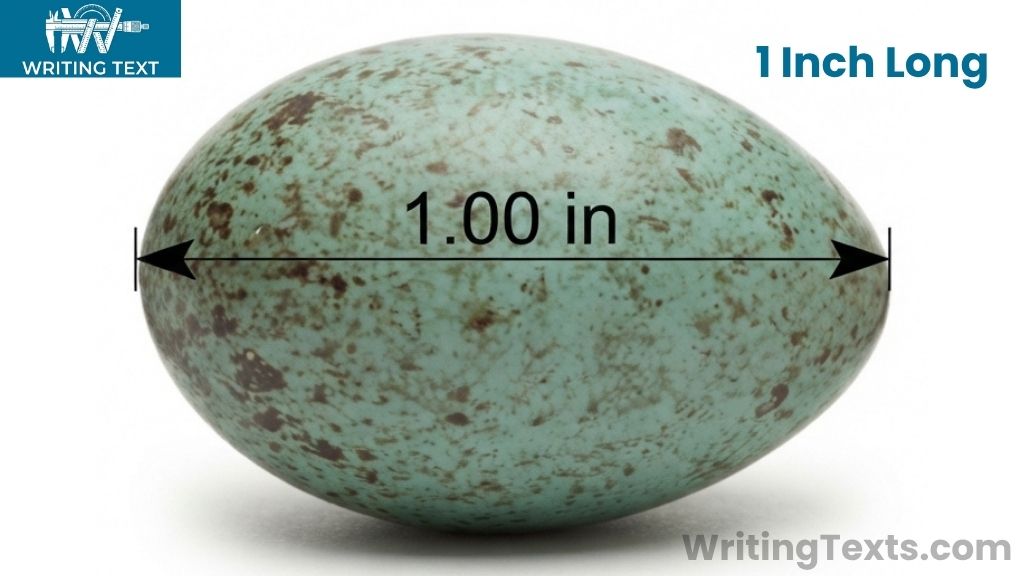
A blue jay egg measures commonly around 1 inch along its shorter measured axis, making it a precise natural reference for this dimension.
The short axis of the egg measured across its widest middle point rather than tip to tip—sits right at the 1-inch mark. Blue jay eggs fall under a tightly clustered size range dictated by the species’ body cavity dimensions, with ornithological records consistently placing minor axis measurements between 0.95 and 1.05 inches across clutches studied in North America.
Placed flat on a surface next to a thumb knuckle, the egg’s width tracks closely with the distance from the tip of an adult thumb to its first joint—a measurement most adults carry without knowing it.
2. Heavy-Duty Key Ring
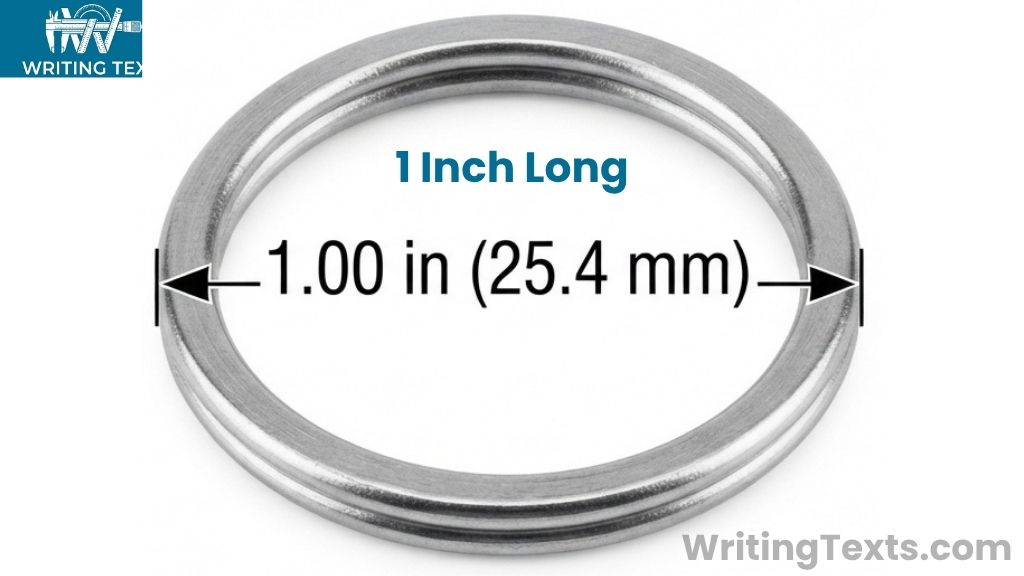
A heavy-duty key ring’s outer diameter commonly sits near 1 inch, distinguishing it clearly from standard lightweight split rings sold alongside it.
The outer diameter is measured edge-to-edge across the full circle of the ring, not the inner gap where keys actually thread through. Heavy-duty rings in this size class are manufactured from thicker steel wire—typically 1.2mm to 1.5mm gauge—which accounts for why the inner usable opening runs slightly smaller at roughly 22mm. At 1 inch across, this ring size is the standard choice for key organization systems, badge holders, and lanyard hardware where load stress is a real factor.
3. Standard Cabinet Knob
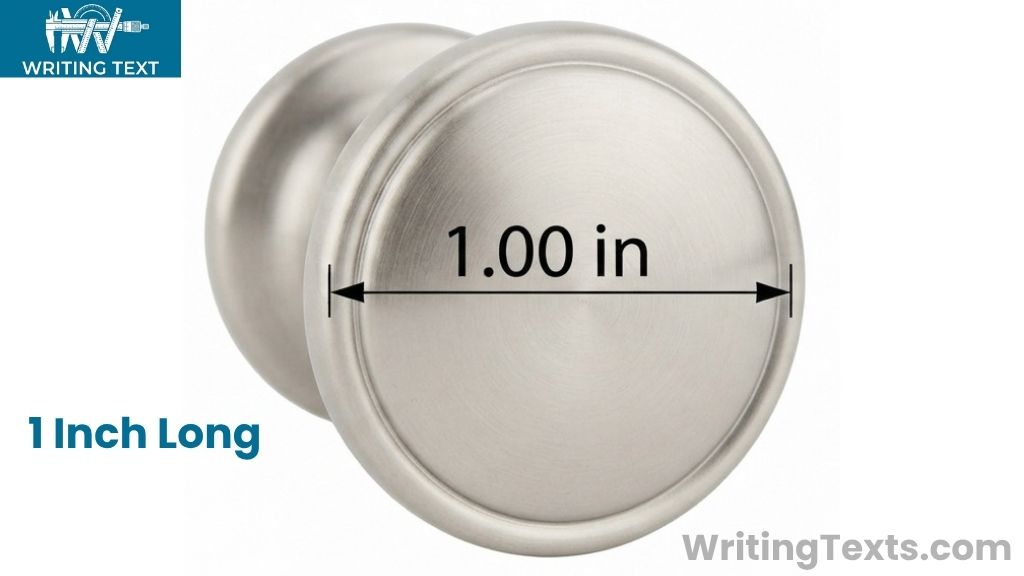
The face diameter of a standard cabinet knob—the circular surface your fingers contact—is typically manufactured near 1 inch.
Cabinet knob sizing in retail hardware follows a convention where face diameter and base diameter are measured separately, and the 1-inch face measurement refers only to the flat or domed front surface visible when the cabinet is closed.
This dimension became the dominant standard because it fits comfortably between three adult fingertips without requiring a full grip, reducing wrist strain during repeated use in kitchen cabinetry. On a cabinet door, a 1-inch knob face occupies roughly the same visual footprint as a U.S. quarter coin pressed flush against the wood.
4. Gym Locker Padlock
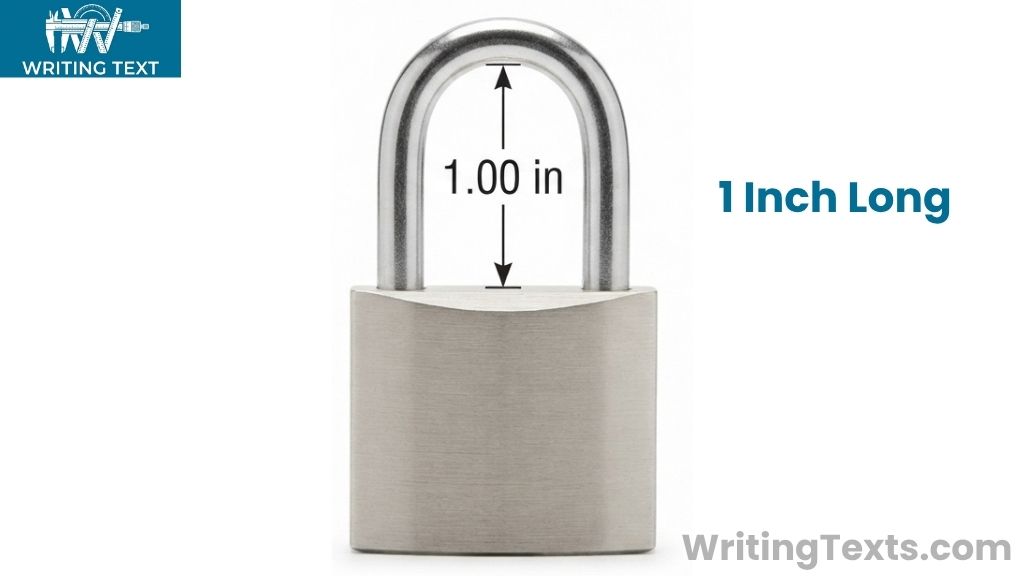
The shackle clearance on a standard gym locker padlock—the open gap between the shackle arc and the lock body—commonly measures right at 1 inch.
Shackle clearance is defined as the vertical distance from the top of the lock body to the inside base of the shackle’s curved section, which is the functional space that must clear a locker hasp. Most gym-grade padlocks follow the Masterlock and ABUS sizing conventions where a short-shackle model provides exactly enough clearance for 9mm to 10mm thick hasps while deterring bolt cutter access—and that engineering target produces a clearance gap landing near 1 inch. That gap, held between a fingertip and thumb, gives an immediate tactile sense of the measurement without any tool at all.
5. A Standard Paperclip

A standard paperclip the Gem-style clip found in virtually every office supply drawer—is commonly around 1 inch in total length.
The total length is measured from the outermost tip of the larger loop to the base of the smaller inner loop along the clip’s longest axis. The Gem clip design, which has dominated office supply manufacturing since the early 1900s, was standardized at this length because it grips approximately 20 to 30 sheets of 20lb bond paper without distorting—a capacity that happens to require exactly this spine length. Its 1-inch body is narrow enough that two clips laid end-to-end along a standard business card span the card’s entire 2-inch width without overlap.
6. Coquina Seashell
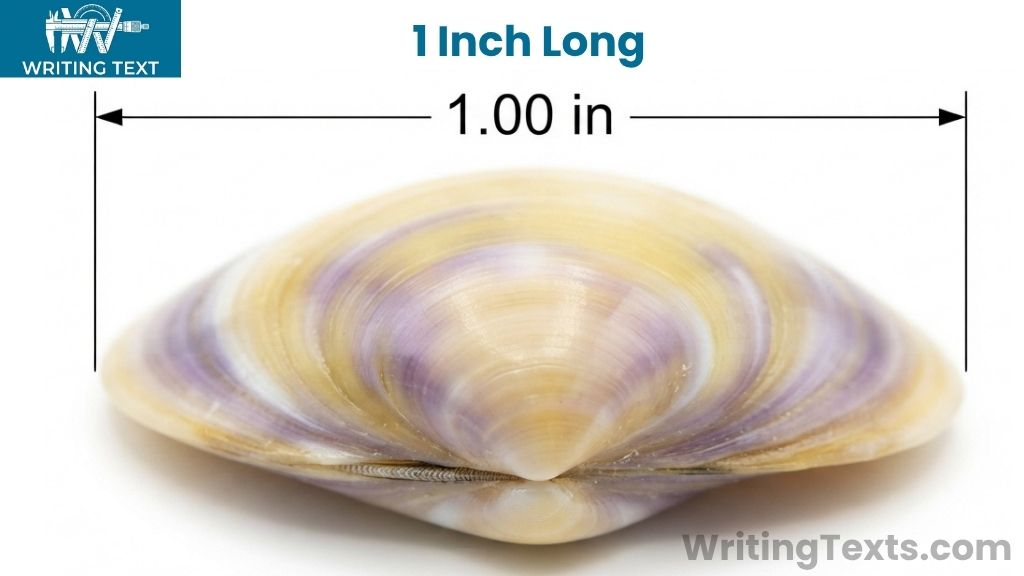
The width of a coquina seashell—measured across the shell’s broadest horizontal point—commonly falls right at 1 inch for mature specimens.
Coquina clams (Donax variabilis) reach their full adult shell width at roughly 0.75 to 1.1 inches, with the 1-inch measurement representing a fully mature individual harvested from intertidal zones along the U.S. Atlantic and Gulf coasts.
Shell width in bivalves is regulated by the animal’s mantle tissue growth rate and calcium carbonate deposition speed, which in coquinas slows dramatically after the first full seasonal cycle—locking most adults into the sub-inch to just-over-inch range. The shell held at its widest point between two fingers gives a clean, tangible cross-reference for the measurement that’s surprisingly consistent across samples found on the same beach.
7. Medium Binder Clip

The mouth width of a medium binder clip—the open gap between the two flat jaws when the clip is relaxed—is standardly manufactured near 1 inch.
Mouth width is the internal measurement between the clip’s two flat steel plates when no paper is inserted and the jaws rest naturally open. The medium clip size classification across brands like Acco, Officemax, and Staples corresponds to a body width of approximately 1.25 inches and a mouth opening targeting around 1 inch, engineered to hold up to 165 sheets of standard paper at maximum compression.
Because the clip is made from cold-rolled steel with a defined spring tension, the jaw opening stays consistent across units—making it a more reliable 1-inch reference than many organic or handmade items.
Related: How Long is 3 Inches? 13 Common Things That Are 3 Inches Long
8. Class 15 Sewing Bobbin
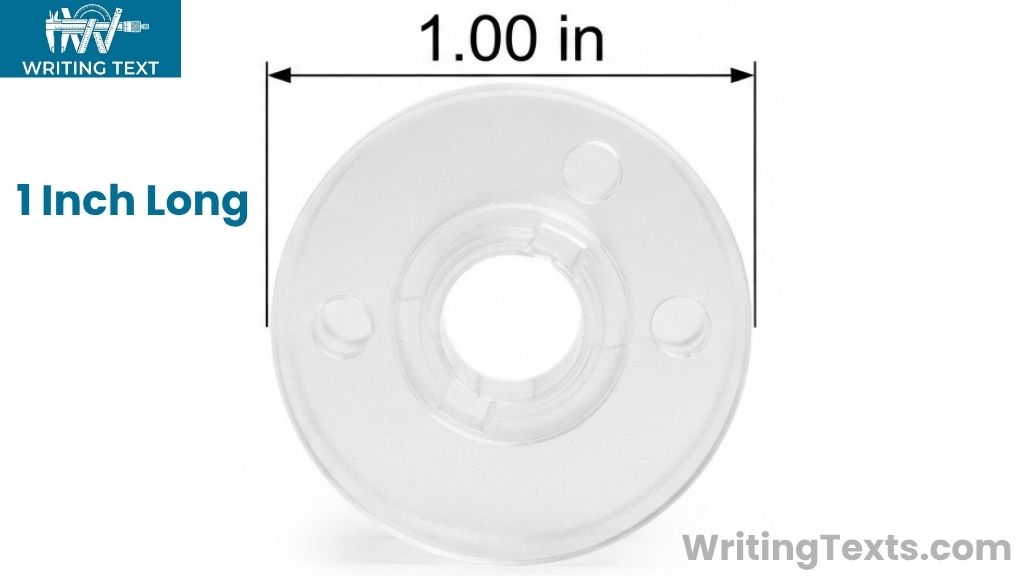
A Class 15 bobbin—the most widely used sewing machine bobbin type in domestic machines—has an outer diameter that sits commonly around 1 inch.
The outer diameter measurement runs across the flat face of the bobbin disc, from one outer edge to the other, not including the raised flanges on either side. Class 15 bobbins are standardized to fit the hook assembly of high-volume domestic machines from Brother, Singer, and Janome, where the bobbin diameter directly determines thread tension and stitch consistency.
The coin-like disc shape and near-1-inch diameter make it one of the few standardized mechanical components a home sewer handles regularly that doubles as a precise physical reference for the measurement.
9. Large Watch Band
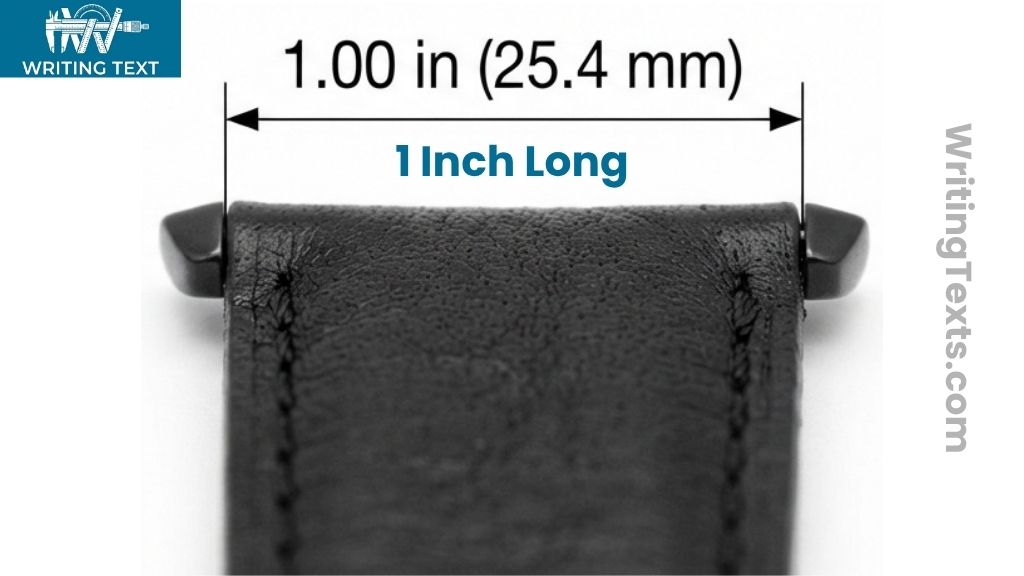
The lug width of a large watch band—the dimension that determines fitment into a watch case—is commonly manufactured at 1 inch, equivalent to 24mm to 26mm in the metric sizing used by watchmakers.
Lug width is measured between the two protruding lug posts on the watch case where the strap attaches, and it is the only measurement that determines whether a band will fit without modification. Watch bands marketed as “large” or sized for sport and dive watches above 44mm case diameter routinely carry a 24mm lug width, which rounds to just under 1 inch, while some oversized designs reach 26mm—just over. The physical strap section between the lugs, when pressed flat against a thumbnail, maps almost exactly to the width of an average adult’s thumbnail at its widest point.
10. Square Mosaic Tile
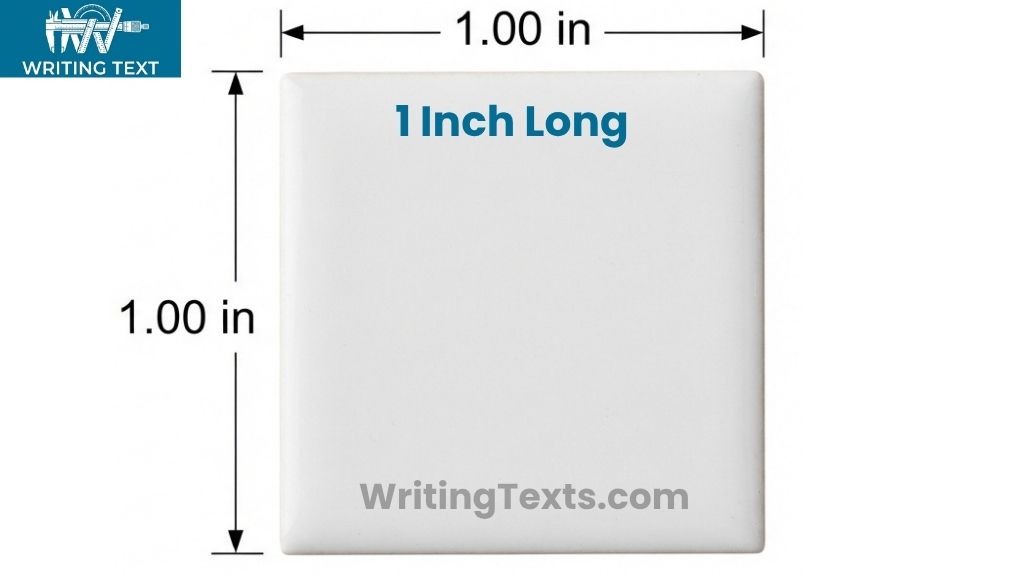
A square mosaic tile—the individual glass or ceramic piece in standard mesh-mounted mosaic sheets—commonly measures 1 inch per side across its face.
The face width of each individual tile unit in standard mosaic sheets is measured from one cut edge to the parallel opposite edge, excluding the grout gap built into the mesh spacing. The 1-inch individual tile size became the dominant mosaic standard because it produces a grout joint of approximately 1/16 inch when mesh-mounted, hitting the aesthetic and structural balance that tile setters and interior designers consider optimal for backsplash and floor installations.
A single tile resting on a fingertip nearly covers the entire width of an adult index fingernail—a scale that makes them feel deceptively small until they’re arrayed across a surface in the hundreds.
11. The Natural “Pinch” Width

The pinch width—the gap between the tip of a relaxed adult thumb and the tip of the index finger when held in a natural pinch position—is commonly around 1 inch for most adults.
This measurement is taken with both fingers curved naturally as if picking up a small object, without forcing the fingers apart or pressing them together, and represents the passive resting gap between the two fingertips.
Human hand anthropometric data from ergonomic design studies places the average adult pinch span in this position between 0.9 and 1.1 inches, with minimal variance across different hand sizes because the gesture is constrained by the specific joint geometry of the distal phalanx. This makes the pinch one of the most reliable body-based references for 1 inch that requires no tools, no training, and no conscious measurement technique.
Related: How Tall Is 96 Inches? 13 Things That Are 96 Inches Long
12. CPU Thermal Paste
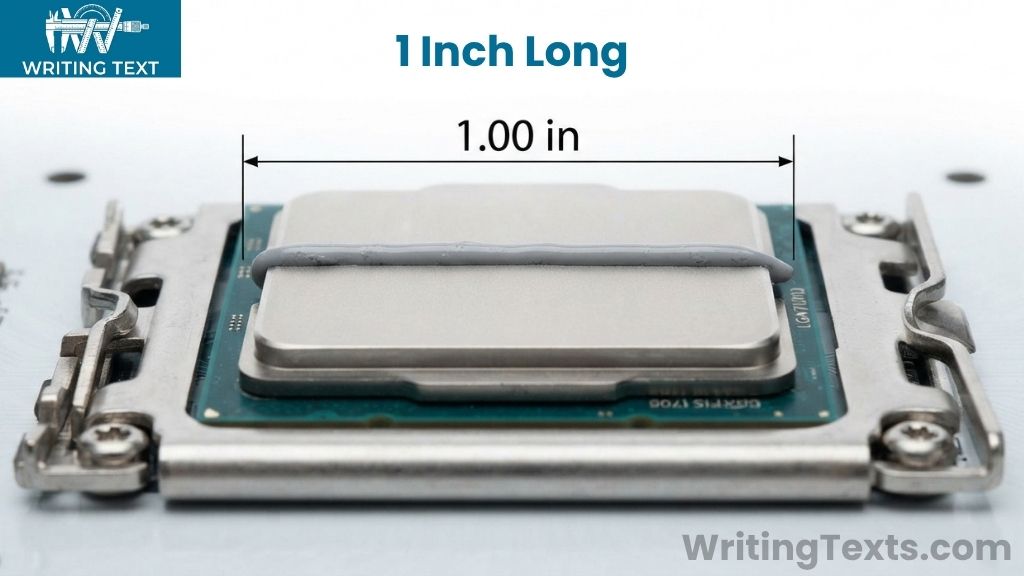
A thermal paste line applied correctly to a desktop CPU—using the standard line method recommended by most processor manufacturers—is commonly around 1 inch in length.
The line method involves applying a thin bead of compound along the center of the CPU’s integrated heat spreader, running parallel to its longest edge, and the target line length for standard desktop processors like Intel’s LGA1700 or AMD’s AM5 is close to 1 inch before the cooler spreads it under mounting pressure.
Thermal compound manufacturers including Noctua and Arctic specify this line length in their application guides because it delivers optimal compound spread coverage across the die area without overflow onto the socket contacts. That thin bead—barely wider than a pencil line but sitting right at 1 inch long—is one of the more precise real-world uses of this measurement in consumer electronics.
How to Estimate 1 Inch Without Tools
The tip of an adult thumb—measured from the very tip of the nail to the first knuckle joint—averages between 1 and 1.1 inches on most adults. This knuckle-to-tip span works as a fast rough check and requires no external object at all. Variance does exist: people with larger hands may find this span closer to 1.2 inches, while smaller hands can run 0.85 inches or less, so treat it as an approximation, not a precision tool.
A U.S. quarter dollar coin measures 0.955 inches in diameter—just under 1 inch by less than half a millimeter. Two quarters placed side by side span roughly 1.9 inches, which means a single quarter gives a near-perfect lower-bound visual anchor for the measurement without being exactly there.
This method is particularly useful for checking hardware gaps and drilled hole diameters when a caliper isn’t nearby, though the slight shortfall means any fit-critical application still warrants a physical measuring tool for final confirmation.
1 Inch Compared to Similar Sizes
| Measurement | Size in Feet | Size in CM | Scale Comparison |
| 0.5 inch | 0.042 ft | 1.27 cm | Width of a pencil eraser |
| 0.75 inch | 0.063 ft | 1.91 cm | Standard zipper pull width |
| 1 inch | 0.083 ft | 2.54 cm | Standard paperclip length |
| 1.25 inches | 0.104 ft | 3.18 cm | Medium binder clip body width |
| 1.5 inches | 0.125 ft | 3.81 cm | Standard AAA battery diameter |
| 2 inches | 0.167 ft | 5.08 cm | Width of a U.S. dollar bill’s short edge section |
FAQs About 1 Inch
How long is 1 inch in centimeters?
One inch equals exactly 2.54 centimeters, a conversion fixed by international standards agreement in 1959 and used universally in science, manufacturing, and retail.
How long is 1 inch in millimeters?
One inch equals 25.4 millimeters. This is the most precise metric equivalent and is the standard used in machining, woodworking, and electronics specifications.
How long is an inch on a ruler?
On a standard 12-inch ruler, 1 inch spans the distance between any two consecutive numbered marks, divided internally into 16 equal segments each representing 1/16 of an inch.
What common household object is 1 inch long?
A standard Gem-style paperclip is commonly around 1 inch in total length and is found in almost every home and office, making it the most accessible everyday reference.
How long is 1 inch of hair?
One inch of hair growth is roughly the length from a fingertip to just past the first knuckle joint. At an average growth rate of about 0.5 inches per month, 1 inch of new growth typically takes around six weeks.
Is 1 inch the same as 2.5 cm?
Not precisely. One inch equals 2.54 cm, not 2.5 cm. The 0.04 cm difference is negligible for casual reference but becomes significant in precision manufacturing, medical devices, and fine jewelry sizing.
How do I measure 1 inch without a ruler using my finger?
The distance from the tip of an adult thumb to the first knuckle joint averages close to 1 inch for most adults, though this varies by hand size and should only be used as a rough field estimate.
The blue jay egg—roughly 1 inch across its short axis—and the Class 15 sewing bobbin—a near-perfect 1-inch disc—are two of the most physically distinct and easy-to-handle references for this measurement. One inch is a deceptively compact dimension that governs an enormous range of everyday hardware, nature, and consumer product sizing. Keeping one of these objects nearby removes all guesswork the next time the number comes up.
Discover More Measurement Articles:
- 13 Daily-Use Things That Measure 102 Inches Long – 2026
- 10 Daily-Use Things That Measure 59 Inches Long – 2026
- Top 10 Daily-Use Things That Measure 20 Inches Long – 2026
- 10 Daily-Use Things That Measure 40 Inches Long – 2026

I’m Karan Singh. I write about measurements, dimensions, and everyday size comparisons. I focus on making numbers easy to understand — no confusing terms, just clear and simple explanations. I use real-life examples so anyone can picture the size in their head. My goal is to help people find quick, accurate answers without any guesswork.